Building the manufacturing
layer for AI medicine.
AI changed what can be imagined.
Invitris changes what can be delivered.
Backed by




The science is ready.
The factories are not.
AI can now design drugs faster than today's manufacturing infrastructure can produce them. We strive to mass-manufacture individualized drugs.
AI expands what can be designed.
AI has reached a stage where modeling proteins (antibodies, phages, vaccines, etc.) has become democratized. Designing fully de-novo proteins for individual targets is now possible.
Biomanufacturing was built for one-size-fits-all.
The infrastructure was designed for one drug at scale, not millions of variants at single-patient economics. This creates the new bottleneck: mass manufacturing. One-size-fits-all drugs are not the basis of a future where patients are treated algorithmically.
Invitris is the manufacturing layer.
From sequence to drug substance in four to eight hours, built for the economics of individual medicine.
Works where cells fail.
One machine. Any protein/drug. In hours.
Under GMP. Aseptic. End-to-end. For a wide range of protein classes.
Single-step process. Autonomous processing.
Built for the economics of individual medicine, not one-size-fits-all.
From digital sequence to physical molecule.
Gross margin at $1–2k COGS vs. $5–10k traditional.
More output than the leading technology.
Less endotoxin — cost-effective purification.
Three domains where today's manufacturing technologies fall short.
Pathogen-specific antimicrobials. Ready in days, not weeks.
Microbial evolution leads to the largest health-economic problem of our time: antimicrobial resistance (AMR). Tailoring antimicrobials such as bacteriophages is key to minimise resistance and maximise efficacy.
Platform for individualized manufacturing. Ready drugs for single patients.
Protein-based therapies, including antibodies, multispecifics, peptides, enzymes, and cytotoxic proteins. Perfectly designed to integrate into a therapeutic process enabled by AI modeling.
On-demand production.
We're building Invitris Pods — autonomous biomanufacturing machines for decentralised, on-demand production. No supply chain dependency. Countries produce what they need, where they need it.
A complete design test stack
From your design, at clinical pace.
Computational design coupled to high-throughput wet-lab validation.
The design-test loop closes in days, not quarters.
One platform, from first screen to GMP-relevant volumes.
"Invitris is leading the way on advancing the pace of AI-guided design for the production of therapeutic products. Their autonomous GMP manufacturing capabilities set them apart."
Scientific Advisor to Invitris
Cell-free protein synthesis
Programmable reactions that turn DNA directly into functional proteins,
antibodies, and phages — no fermentation, no host cells.
1,000 proteins per second
Microfluidic screening at a throughput that was simply not
possible with conventional expression systems.
Sequence to structure
Computational design coupled to high-throughput wet-lab validation
close the loop in days, not quarters.
Picoliter to liter
Seamless scale-up from screening droplets to GMP-relevant
production volumes on a single platform.
Selected for the SPRIND Orbital Bioworks Challenge
July 30, 2026
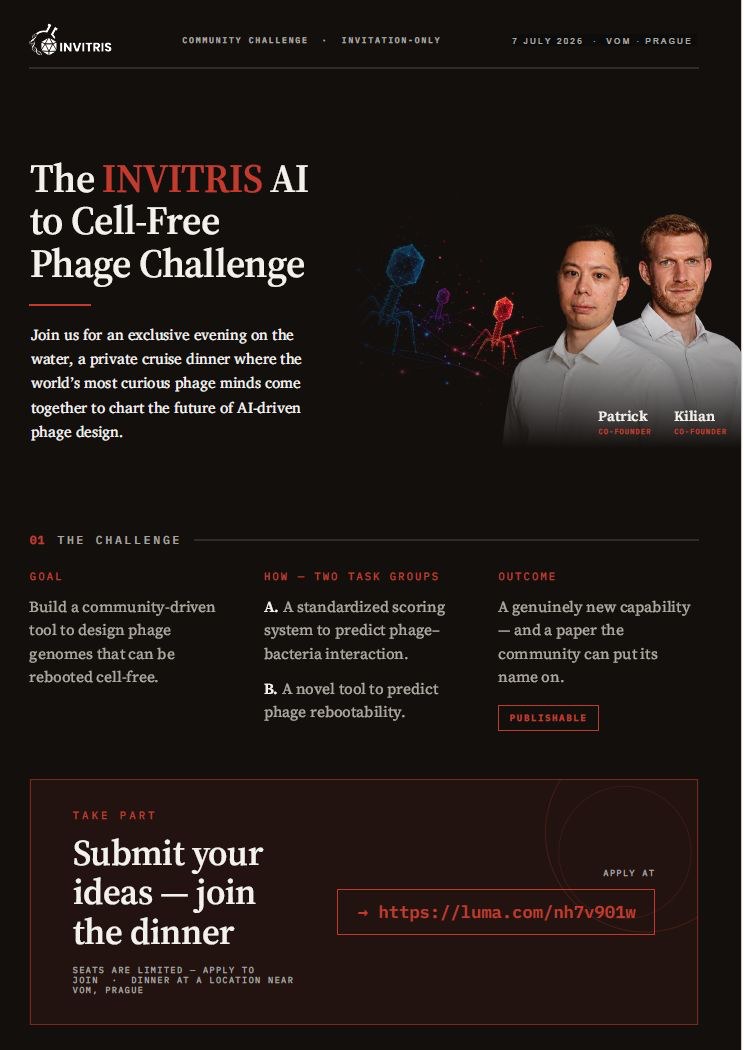
AI-to-Phage Challenge launched at Viruses of Microbes 2026
July 7, 2026
Invitris receives €250,000 for complete spin-off from TUM
January 1, 2021
Platform validated across 26 product classes in 20 paid POCs
May 21, 2026
Awarded EIC Accelerator — €2.5M nondilutive funding and €10M matching equity
July 1, 2025
Cell-free production of customised therapeutic phages featured in Science
November 1, 2022